The Tsumami-Zaiku Shown at Japan's 1908 Exposition Was a Kusudama
At Japan's 1908 industrial exhibition, tsumami-zaiku was represented by exactly two pieces, from one exhibitor. And the piece the judges described was a kusudama — a decorative ball built from several dozen folded silk flowers. They looked at it and wrote that there was, essentially, nothing to say about it. Then they added one more line, beginning with the word 然レトモ — "however."
In our first two articles in this series we read from a 1909 instruction manual, Tsumami-zaiku Shinan. This time we go back one year earlier, to an exhibition judges' report, and read the passage in the original.
The source
Tokyo Kangyō Hakurankai Shinsa Hōkoku (東京勧業博覧会審査報告, "Report of the Judges of the Tokyo Industrial Exhibition"), volume 7, published 1908 (Meiji 41). It is a government publication, digitized in full and freely viewable through the National Diet Library Digital Collections as PID 801790. Published more than a century ago, it is in the public domain.
The relevant passage is on image 73, in a section classified as Part 13, Category 120-2: 押繪及摘細工品 — "oshi-e and tsumami-zaiku work." Oshi-e is a separate craft, in which padded fabric shapes are mounted in relief (most familiar on decorated hagoita paddles). The two crafts were judged together in one section. The four judges were Nakamura Takashi, Ide Umatarō, Yoshitake Einoshin, and Kasahara Kichitarō.
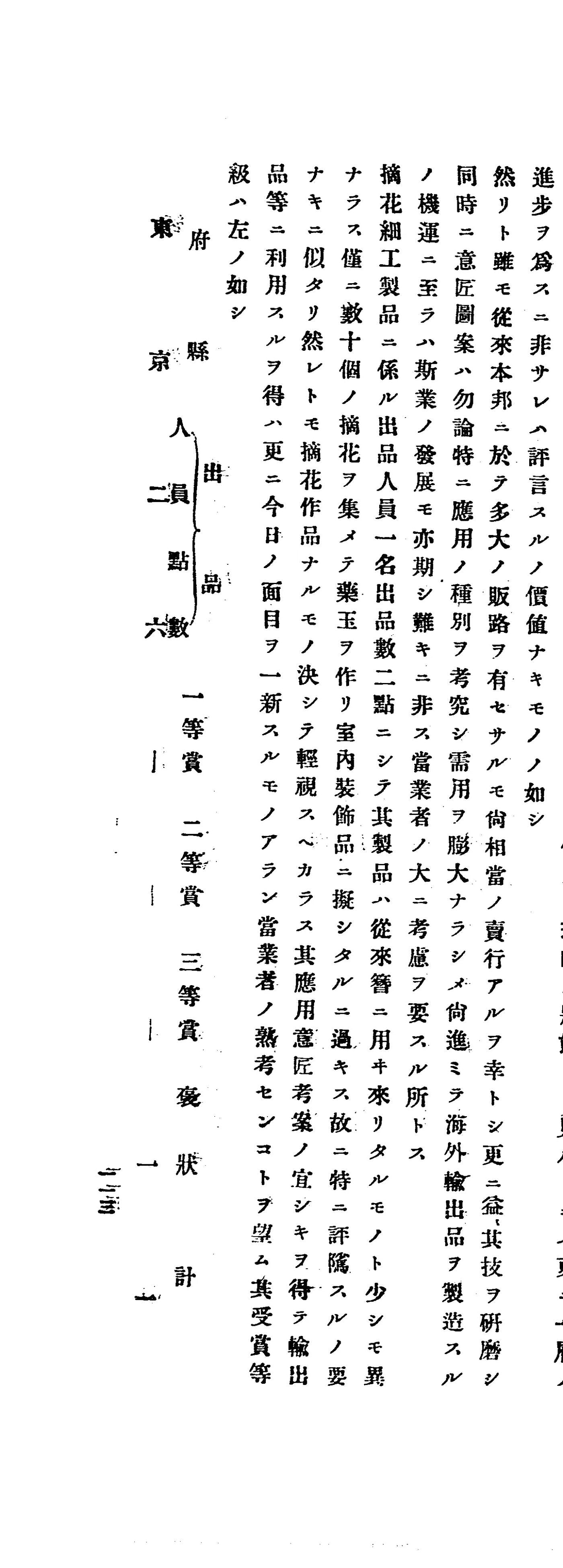
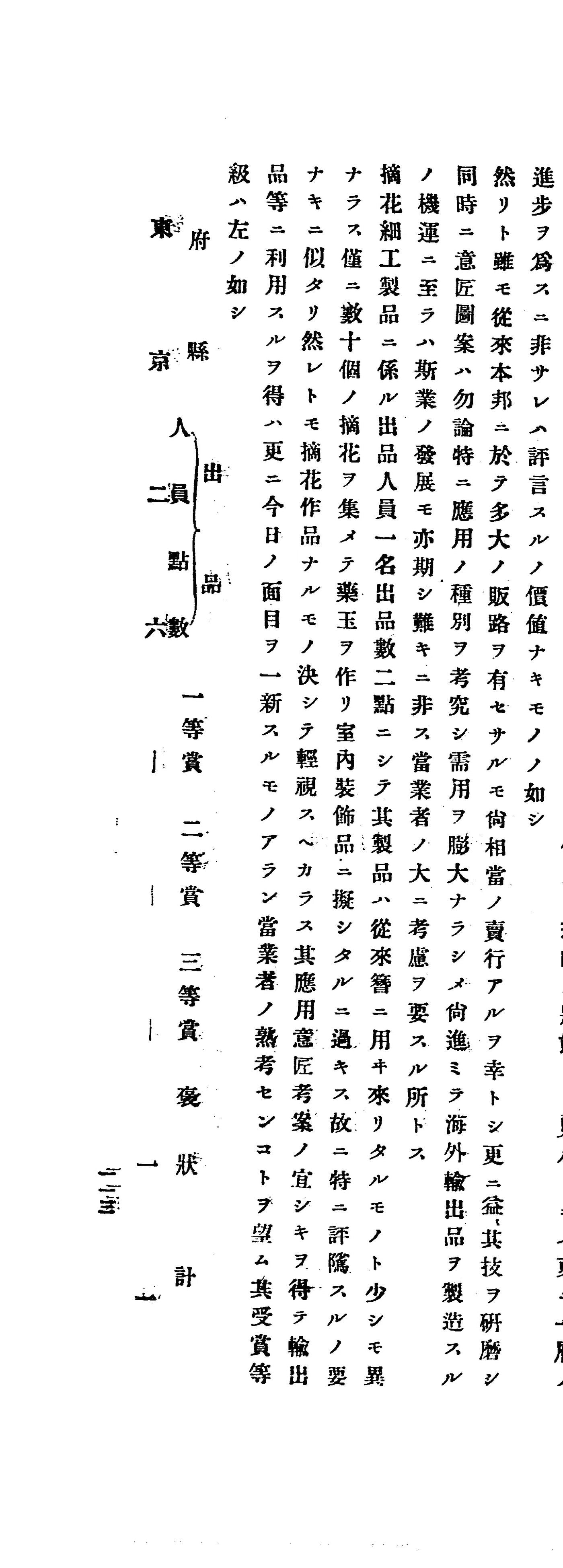
For the section as a whole, the report records two exhibitors and six pieces, all from Tokyo Prefecture, with one third-place prize and one certificate of merit. But that figure covers oshi-e and tsumami-zaiku combined. For tsumami-zaiku alone, the report is specific: "摘花細工製品ニ係ル出品人員一名 出品數二點" — one exhibitor, two pieces.
Article 1: Is tsumami-zaiku originally Japanese? / Article 2: Why tsumami-zaiku did not spread
What was actually exhibited: a ball of silk flowers
The report describes the work itself. Here is the original passage:
摘花細工製品ニ係ル出品人員一名出品數二點ニシテ其製品ハ從來簪ニ用キ來リタルモノト少シモ異ナラス僅ニ數十個ノ摘花ヲ集メテ藥玉ヲ作リ室内裝飾品ニ擬シタルニ過キス故ニ特ニ評隲スルノ要ナキニ似タリ

In English: "For tsumami-zaiku work there was one exhibitor and two pieces. The work is in no way different from what has long been used on kanzashi. It is merely several dozen tsumami flowers gathered together to form a kusudama, presented as an interior decoration. There would therefore seem to be no particular need to appraise it."
The tone is plainly cool. Same technique as always. Assembled into a ball. Nothing new. The judges say so in as many words.
What the passage also records, though, is that a tsumami-zaiku kusudama existed in 1908 and was finished enough to be entered in a national exhibition. The kusudama we still make today — silk flowers folded one at a time and gathered into a sphere — was being made in the same form at least 118 years ago.
"However" — and the judges reverse themselves
The report continues directly into the next sentence:
然レトモ摘花作品ナルモノ決シテ輕視スヘカラス其應用意匠考案ノ宜シキヲ得テ輸出品等ニ利用スルヲ得ハ更ニ今日ノ面目ヲ一新スルモノアラン當業者ノ熟考センコトヲ望ム
In English: "However, tsumami-zaiku work is by no means to be taken lightly. If its application, design, and invention are well handled, and it can be turned to use as an export product and the like, this craft would take on an entirely new standing. We hope those in the trade will consider this deeply."
The most interesting thing in this document is that word 然レトモ, "however." Having just written that the exhibited work merited no comment, the judges did not stop. They turned, in the same breath, from the object to the technique — finding value in the method rather than the piece — and wrote that with the right application and design it could become an export product. Then they closed with a direct appeal: tōgyōsha no jukkō sen koto o nozomu, "we hope those in the trade will think hard about this."
This is not politeness toward an exhibitor. They declined to praise the work, and wrote the line anyway.
This was a judges' opinion, not a government policy
One thing needs to be stated clearly. This passage is part of a report evaluating works submitted to an exhibition. It is not a policy document in which the Japanese government designated tsumami-zaiku for export promotion. It was written by the four judges responsible for this section, as their professional assessment of what they saw. Nothing in this source supports the claim that "the Japanese government decided to make tsumami-zaiku an export product." What the source establishes is narrower and more precise: that exhibition judges, in an official published record, made that assessment and offered that recommendation.
One related note, to prevent a misreading. Immediately before this, the same section contains an even stronger statement about export: "尚進ミテ海外輸出品ヲ製造スルノ機運ニ至ラハ斯業ノ發展モ亦期シ難キニ非ス" — "should the momentum arise to manufacture goods for export overseas, the development of this trade is not beyond expectation." That sentence is about oshi-e, not tsumami-zaiku. We note it here so that it is not mistaken for the tsumami-zaiku passage.
One year later, the manual reported a boom
The year after this report, in 1909 (Meiji 42), Yamada Okimatsu published Tsumami-zaiku Shinan. It opens with this:
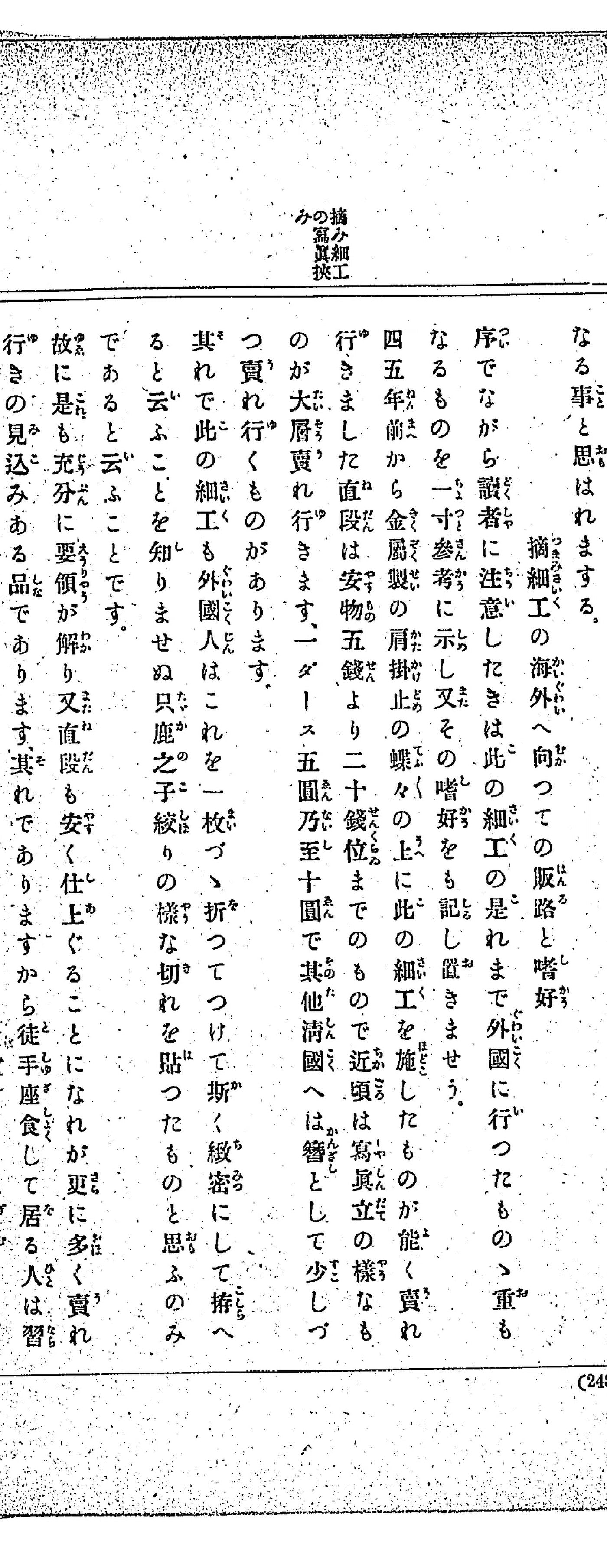
此の摘み細工の技藝が近時盛んに流行ばれ始めて、各技藝學校并に高等女學校等の技藝科に造花と共に加へられ、又賣品としては種々の意匠を施し之を各方面に應用して店頭に陳列さるゝを見受ける様になりました
"This craft of tsumami-zaiku has recently come into wide fashion, and has been added alongside artificial-flower work to the craft curricula of technical schools and girls' higher schools; and as a commercial item, we now see it displayed in shops in various applications and designs."
A craft recorded in 1908 as a single exhibitor with two pieces is described one year later, by a professional in the field, as having come into wide fashion.
Here too, a distinction is needed. There is no evidence that the judges' passage caused the following year's popularity. What the sources give us is a sequence: two records, one year apart. Joining them into "this is what started it" would be adding a story the sources do not contain, and we are not going to do that. We simply set the two facts side by side.
What the source establishes, and what it doesn't
This is what the source establishes. In 1908, at the Tokyo Industrial Exhibition, tsumami-zaiku was represented by one exhibitor and two pieces, and the work described was a kusudama built from several dozen folded silk flowers. The judges assessed it as no different from what had long been made, and as warranting no particular comment — and then wrote that the craft was by no means to be taken lightly, that with the right application and design it could serve as an export product and take on an entirely new standing, and that those in the trade should consider this seriously.
Whether this reflected government export policy, whether the recommendation led to anything, whether the following year's popularity had any connection to this report — none of that can be determined from this source. We won't write what the source doesn't say. We report what it does.
About Oharibako (Kyoto)
Oharibako has been making kanzashi (traditional Japanese hair ornaments) and kimono accessories in Nishijin, Kyoto, using pure silk and rice starch paste. The craft that a judge in 1908 thought might one day serve as an export is one we now send to customers around the world.
Is Tsumami-Zaiku Originally Japanese? What a 1909 Manual Says
Why Tsumami-Zaiku Did Not Spread: What a 1909 Manual Named as the Cause
Source
Tokyo Kangyō Hakurankai Shinsa Hōkoku, vol. 7, 1908. Part 13, Category 120-2, "押繪及摘細工品." Judges: Nakamura Takashi, Ide Umatarō, Yoshitake Einoshin, Kasahara Kichitarō. National Diet Library Digital Collections, PID 801790, image 73. Public domain. All quotations transcribed directly from the original scanned page.