"Tsumami-Zaiku" Is a Meiji-Era Name. In the Edo Period It Was Called Kirezaiku.
For a long time our research kept hitting the same wall. Search Edo-period Japanese sources for the word tsumami-zaiku and almost nothing comes back.
Even the index to *Morisada Mankō*, the great record of late-Edo customs, has no entry for tsumami. It has kanzashi. It has hana-kanzashi. Nothing for the word we use every day.
The explanation turned out to be simple. In the Edo period, this craft was not called tsumami-zaiku.
An 1847 book lists it by name
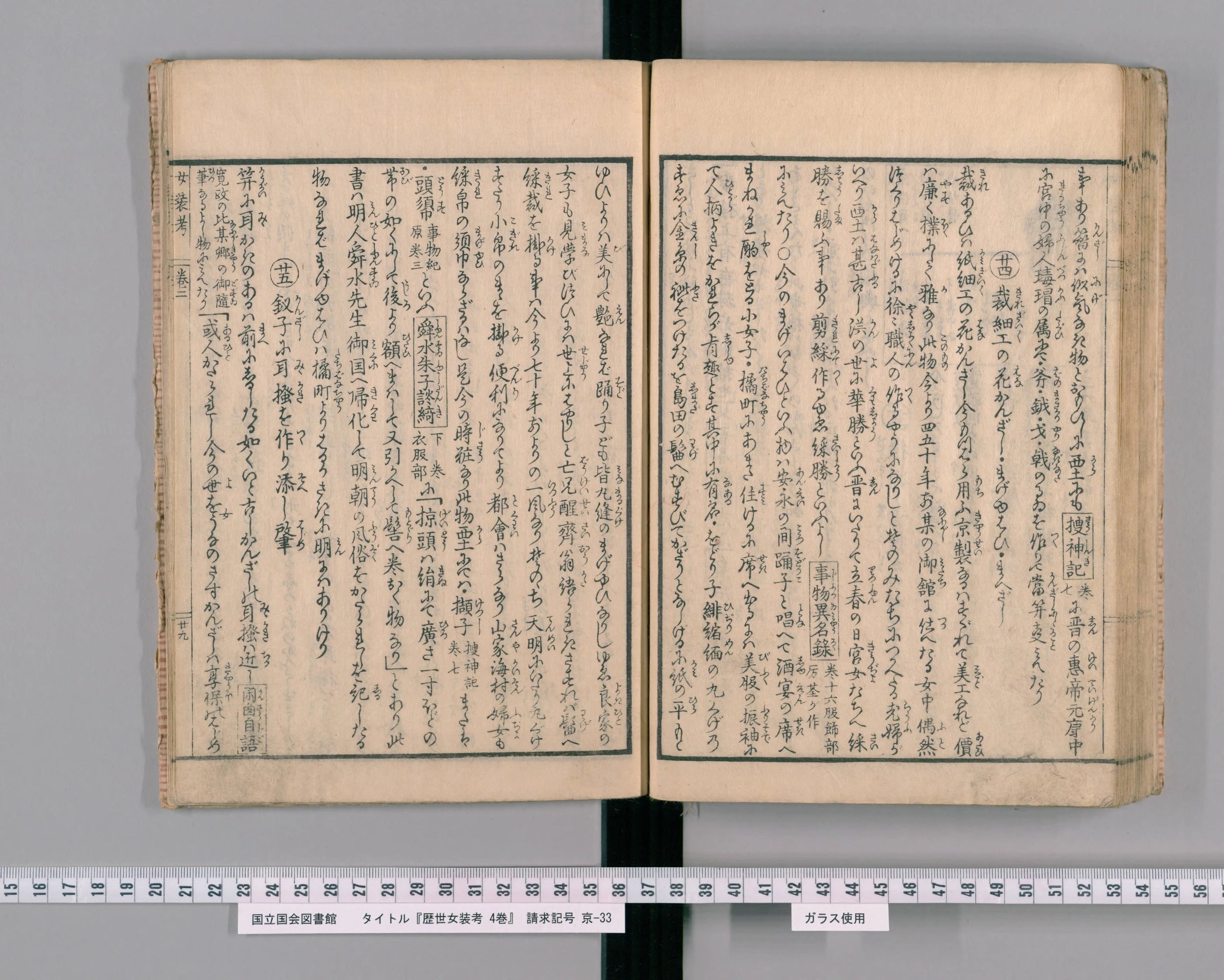
*Rekisei Josōkō* was published in 1847. Its author, Iwase Momoki, wrote under the name Santō Kyōzan. The book is a scholarly study of how Japanese women dressed across the centuries, with particular attention to hairstyles and hair ornaments. It cites more than three hundred earlier works at over five hundred points.
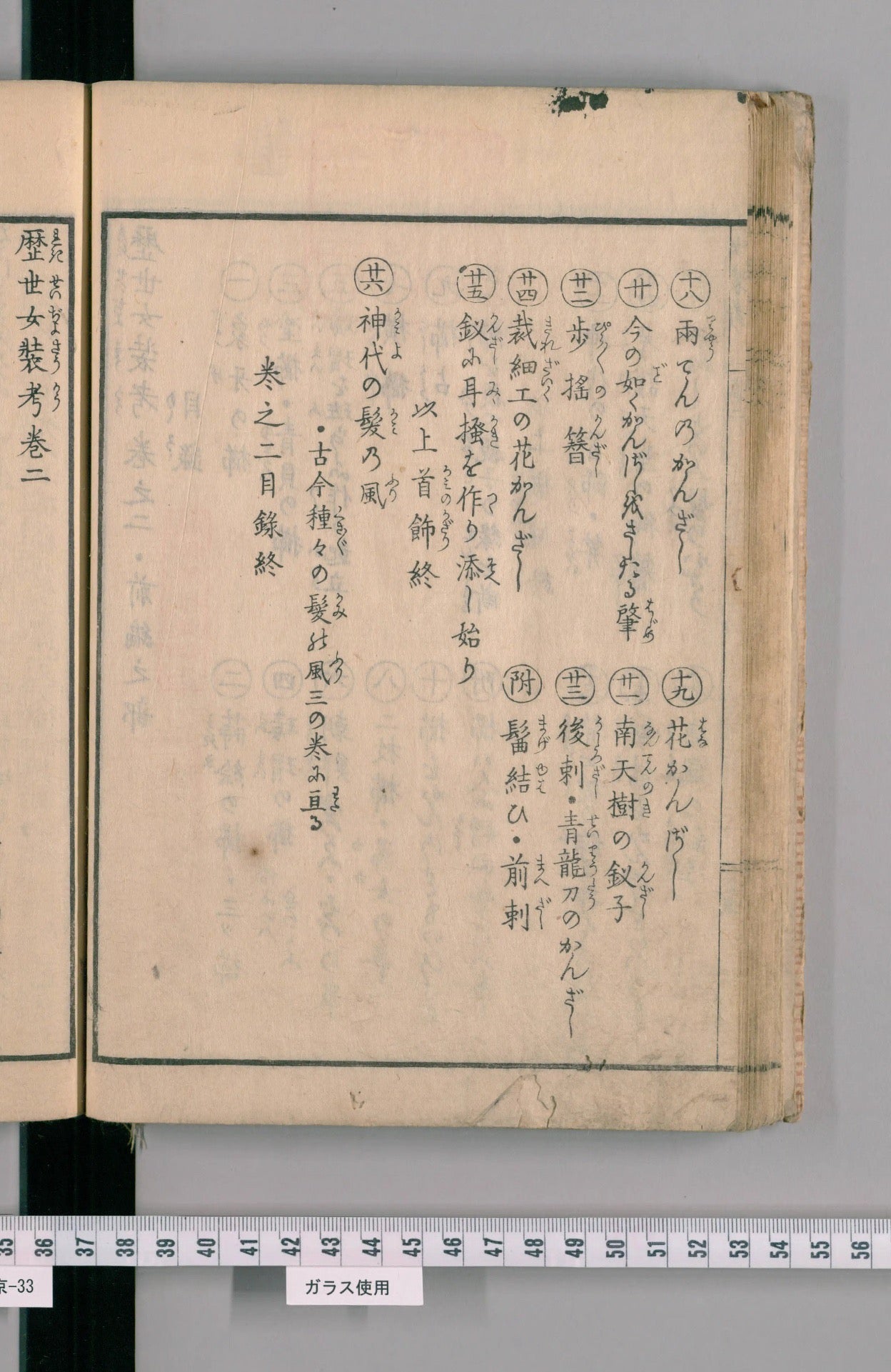
In the table of contents to volume two, item twenty-four reads:
23. Hoyō-kanzashi 24. Kirezaiku no hana-kanzashi 25. The beginning of adding an ear pick to a hairpin

Kirezaiku. The first character means to cut cloth; *kire* is a scrap of fabric. Cloth-scrap work.
It sits between two other hairpin entries, catalogued like any other ornament.
What the text says
The body of the same volume reads:
Hana-kanzashi of cut cloth, or of paper, are in general use today. Those made in Kyoto are especially fine in workmanship, yet they are cheap in price, plain, and elegant. This thing was begun by chance some forty or fifty years ago by a woman serving at a certain household, and gradually artisans came to make it — so said an old woman who had served at that house.
Three things are worth noticing.
First, cloth and paper are named side by side. Paper hana-kanzashi existed then too.
Second, "in general use today." In 1847 this was a current fashion, not a relic.
Third, the origin. Counting back forty or fifty years from 1847 gives roughly 1797 to 1807. But this is hearsay, and Kyōzan says so plainly — an old woman told him.
The word survived into the Meiji era
Kirezaiku did not vanish with the Edo period.
At Japan's First National Industrial Exhibition in 1877, the judges' report records:
Certificate of merit. Kirezaiku framed panel. Ōsawa Nankoku, Hamachō 1-chōme, Tokyo.
The judges' comment: "Toads gathered in a crowd, each of a different shape." Frogs made of cloth, mounted in a frame.
The Japanese catalogue for the 1876 Philadelphia Centennial Exhibition also lists an entry under a related spelling, *sensai-zaiku*.
The year the name changed
So when did it become tsumami?
We searched the full-text database of the National Diet Library for eighteen different spellings. Where a search returned more than a hundred hits, we paged through to the last one so that no early example could be hidden by truncation.
The answer was clean.
In 1877, at the First National Industrial Exhibition, the official term was kirezaiku. In 1891, in the report of the Third National Industrial Exhibition, it is tsumami-zaiku.
Same series of government reports. Fourteen years apart. The word changed in between.
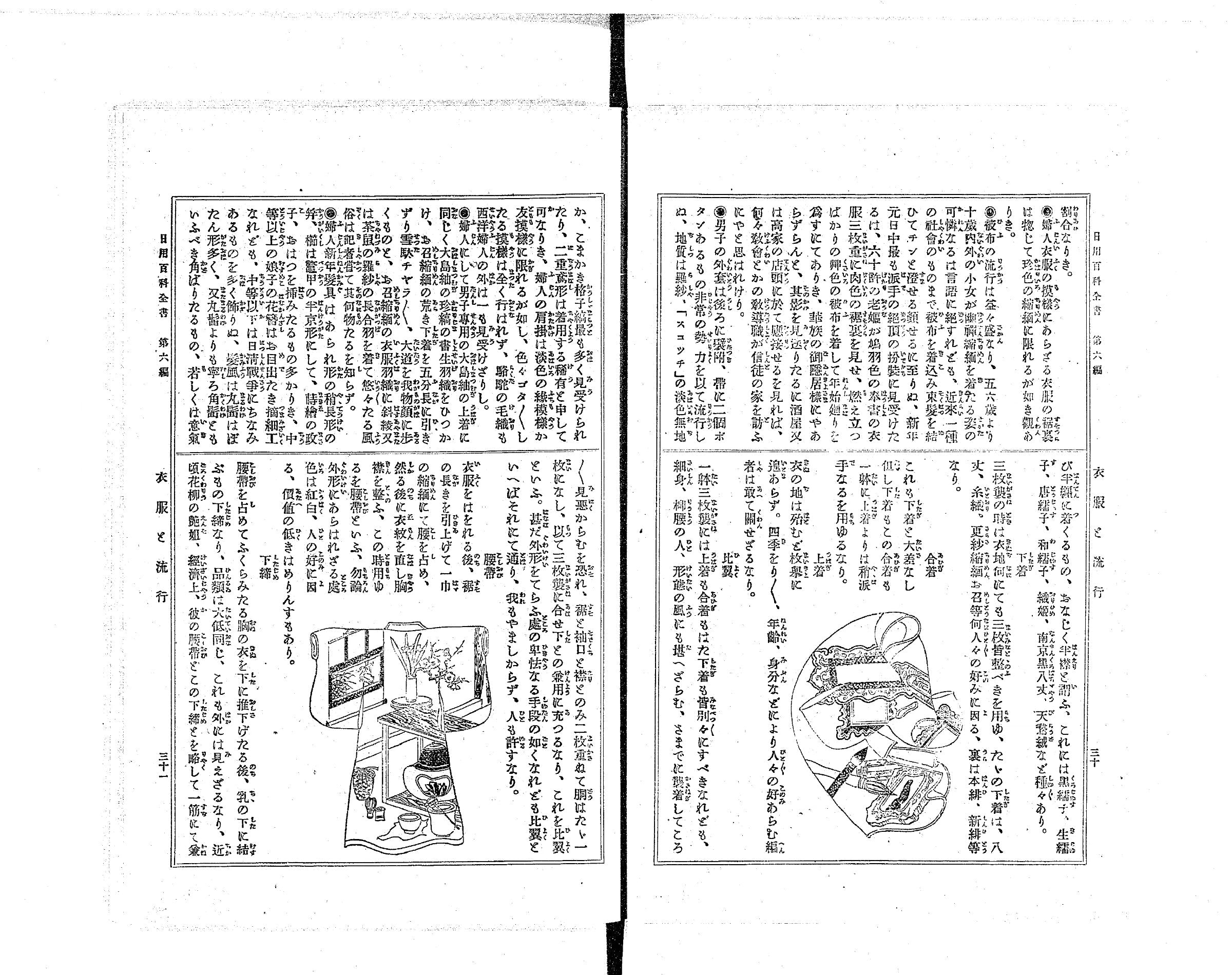
And the reading *tsumami-zaiku* first appears in print in 1895, in a book called *Ifuku to Ryūkō* (Dress and Fashion):
The flower hairpins of daughters of the middle class and above are auspicious tsumami-zaiku, while those below the middle class wore many pieces alluding to the Sino-Japanese War.
The characters for tsumami-zaiku are glossed with the phonetic reading. This is the earliest instance of the pronunciation we can trace.
That sentence also happens to record its moment: the Sino-Japanese War had just been fought, and it was showing up in girls' hair ornaments.
"Tsumami" is a Meiji word
To summarise.
In the Edo period the craft was called kirezaiku — work made from scraps of cloth.
Around 1891 the spelling tsumami-zaiku appears, and by 1895 the pronunciation is in print.
The reading "tsumami" is not an inheritance from the Edo period. It was born in the Meiji era.
We do not think this is trivia. When the name of a craft changes, usually the way it is made and sold is changing too. On the same page of that 1891 report is a passage noting that export routes had greatly expanded. The name changed at the same time the market did.
One thing we are careful about
The word kirezaiku does appear in older sources — in *Tsūki Suigo Den* of 1789, and in the late-Edo essay collection *Wagakoro Shō*.
But the context is different. In *Tsūki Suigo Den* the kirezaiku is decoration on the lanterns of the Yoshiwara pleasure quarter. In *Wagakoro Shō* it appears alongside basket-work and ceramic-work as a kind of sideshow spectacle. Both are large display pieces, not something worn in the hair.
Same word, different object. So we do not cite these as the earliest record of tsumami-zaiku.
**The earliest secure record of kirezaiku as a flower hairpin remains *Rekisei Josōkō* of 1847.** That is as far as we can honestly go.
This changed how we search
Learning this one word changed our method.
We had been searching for tsumami-zaiku and tsumami-saiku. Those words cannot reach Edo-period records, because the records use a different one.
The same is surely true of other terms — names of techniques, of tools, of materials. Searching the past with today's vocabulary leaves things hidden. Going to the primary sources begins with doubting the words themselves.
Why we do this
Tsumami-zaiku is made by folding small squares of silk one at a time and gathering them into flowers. Kyoto Oharibako makes hair ornaments this way, and teaches the craft.
The making has been handed down. Where it came from has been described, we think, more vaguely than it deserves. So we go to the originals rather than to hearsay. We write "we do not know" when we do not know. And when the evidence turns, we correct what we wrote before.
If you would like to learn with your hands: Classes in Kyoto / Online lessons
If you would like to try at home, we stock silk and tools: Tsumami-zaiku materials and tools
More in this series
We read the history of tsumami-zaiku through primary sources held by the National Diet Library of Japan.
In 1873, Kyoto Hana-Kanzashi Crossed to Vienna
Is Tsumami-Zaiku Originally Japanese? What a 1909 Manual Says
Why Didn't Tsumami-Zaiku Spread? A 1909 Manual
The Kusudama Was Meiji Japan's Signature Tsumami-Zaiku
Sources
Iwase Momoki (Santō Kyōzan), *Rekisei Josōkō*, 4 vols., 1847. National Diet Library Digital Collections, PID 2554341 (1855 edition; contents of vol. 2 at image 37, main text at image 65). Another edition, PID 1879499 (summer volume, image 31).
*Kojiruien*, Kiyō-bu 3, Jingū Shichō, 1914. National Diet Library Digital Collections, PID 897878, image 52. Reproduces the same passage as a quotation from *Rekisei Josōkō* vol. 2.
*Nihon Shakai Jii*, vol. 1, Keizai Zasshisha, 1908. National Diet Library Digital Collections, PID 898060, image 448. Also quoting *Rekisei Josōkō*.
*Judges' Reports of the First National Industrial Exhibition, 1877*, vol. 2. National Diet Library Digital Collections, PID 801857, image 38.
*Report on the United States Exhibition*, vol. 2, Japanese catalogue, 1876. National Diet Library Digital Collections, PID 801835, image 60.
*Report of the Third National Industrial Exhibition, Osaka Prefecture*, 1891. National Diet Library Digital Collections, PID 801910, image 42.
*Ifuku to Ryūkō*, Hakubunkan, 1895. National Diet Library Digital Collections, PID 848563, image 29.
*Tsūki Suigo Den*, vol. 1, 1789. National Diet Library Digital Collections, PID 8929923, image 26. *Wagakoro Shō*, 12 vols., Eibian, manuscript. PID 11607889, image 86. Both in the context of sideshow display work.
Translations and summaries are by Kyoto Oharibako. Where our reading of an original is not settled, we say so in the text.