"Kyoto-made Is Especially Fine, Yet Cheap, Plain, and Elegant": What an 1847 Book Said About Kyoto Flower Hairpins
In 1847 a book was published in Edo called *Rekisei Josōkō*. Its author, Iwase Momoki, wrote under the name Santō Kyōzan. It is a study of how Japanese women had dressed across the centuries, argued from earlier books.
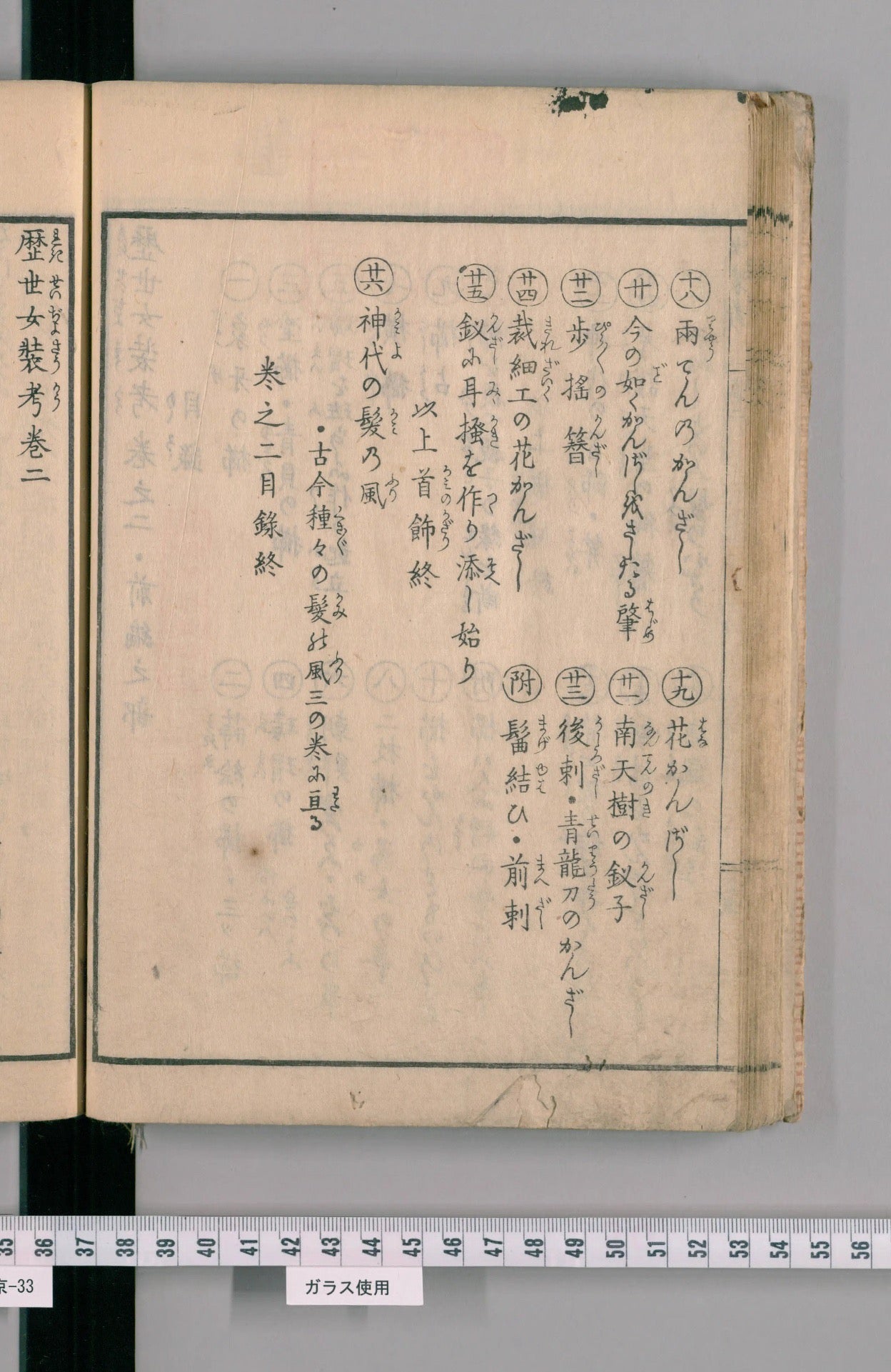
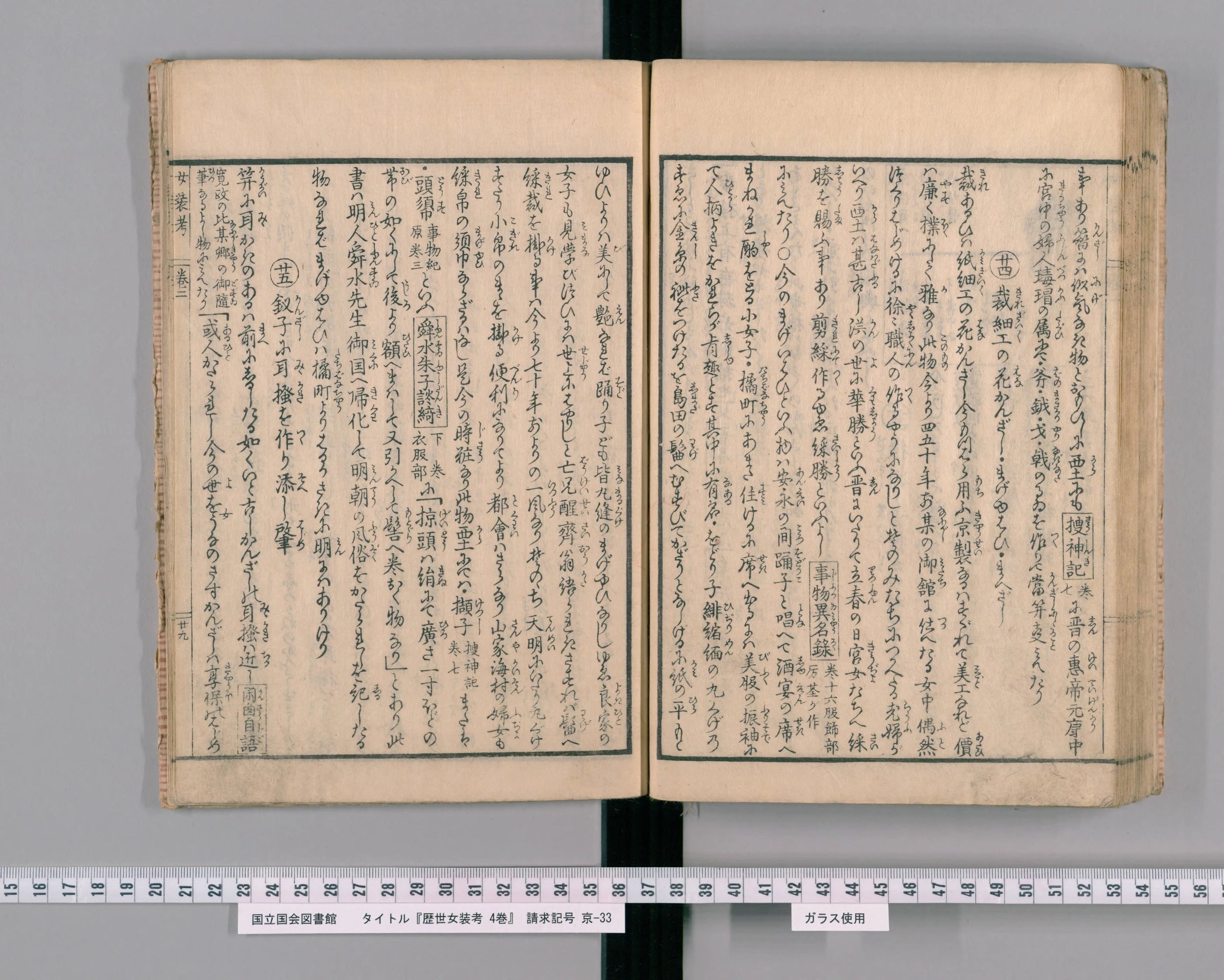
Volume two contains a section on flower hairpins. At the time, the craft was called kirezaiku — cloth-scrap work. In that section is this sentence:
Those made in Kyoto are especially fine in workmanship, yet they are cheap in price, plain, and elegant.

Who wrote it, and where
The first thing to note is that this was written in Edo — that is, in Tokyo.
Santō Kyōzan was an Edo man. His elder brother, Santō Kyōden, was at the centre of Edo popular literature. Kyōzan wrote in Edo, for Edo readers. The book's frontispiece reads "Edo — Iwase Momoki, compiler."
So it was an Edo writer who judged Kyoto work "especially fine." This is not a local boast. It is one production centre acknowledging another.
And this was not a casual essay. It cites more than three hundred works at over five hundred points — a scholarly study, argued source by source. Within it, Kyoto work is singled out by name.
It does not say "fine because expensive"
What struck us most is the second half.
Cheap in price, plain, and elegant.
Craft is usually praised in one direction: elaborate, costly materials, therefore expensive. This book says the opposite. The workmanship is superior, and yet the price is low. Unadorned, and still refined.
The character *boku* means unworked, undecorated. It stands beside *ga*, elegance. Plainness is being counted as the refinement, not despite it.
Skill and restraint together. That, to an Edo observer, was what made a Kyoto flower hairpin.
The same section records Osaka too
This passage survives in *Kojiruien*, a vast classified compendium of Japanese sources compiled by the state. In the entry for hana-kanzashi, several witnesses are set side by side.
*Naniwa no Kaze*, on Osaka:
Women and children rarely use silver hairpins; mostly they use inexpensive things — flower hairpins beautifully made of silk, or of paper. This is the custom of the middle class and below.
Inexpensive again.
Flower hairpins were, from the start, the affordable alternative to precious metal. Within that category, Kyoto's were the finest made. That is the frame in which the 1847 sentence should be read.
The same passage on where it came from
The section also touches on origins.
This thing was begun by chance some forty or fifty years ago by a woman serving at a certain household, and gradually artisans came to make it — so said an old woman who had served at that house.
Counting back from 1847 gives roughly 1797 to 1807.
This is hearsay. Kyōzan says so himself: an old woman told him. We do not treat it as established fact.
Still, one thing stands out. In this account it began with a servant, not a craftsman. An amateur's pastime first; the trade came afterwards.
That is the same order we see in our classroom. No special equipment is needed — scraps of silk, tweezers, a paste board. Someone two hundred years ago could begin by chance for the same reason.
How to take a verdict from a hundred and eighty years ago
Kyoto Oharibako makes tsumami-zaiku hair ornaments in Kyoto. When we found this sentence, it sobered us.
"Those made in Kyoto are especially fine in workmanship, yet they are cheap in price, plain, and elegant."
We read it as a specification, not a title. The work should be thorough. The price should not be inflated. It should not be over-decorated. And it should keep its refinement anyway. Whether we, working in the same city, are living up to what an Edo writer saw here — that is not ours to declare.
The people who hold the finished piece decide.
On going to the originals
We did not find this sentence by looking for it. It surfaced only after we learned that the Edo-period name for the craft was kirezaiku, and searched again with that word.
While we were searching with the modern term, no amount of time would have reached it. One word's difference, and the record stays hidden.
So we go to the originals rather than to hearsay. We write "we do not know" when we do not know. And when the evidence turns, we correct what we wrote before.
If you would like to learn with your hands: Classes in Kyoto / Online lessons
If you would like to try at home, we stock silk and tools: Tsumami-zaiku materials and tools
More in this series
We read the history of tsumami-zaiku through primary sources held by the National Diet Library of Japan.
"Tsumami-Zaiku" Is a Meiji-Era Name. In the Edo Period It Was Called Kirezaiku
In 1873, Kyoto Hana-Kanzashi Crossed to Vienna
Is Tsumami-Zaiku Originally Japanese? What a 1909 Manual Says
Tsumami-Zaiku Fabric: Pure Silk vs. Synthetic
Sources
Iwase Momoki (Santō Kyōzan), *Rekisei Josōkō*, 4 vols., 1847. National Diet Library Digital Collections, PID 2554341 (1855 edition; contents of vol. 2 at image 37, main text at image 65). Another edition, PID 1879499 (summer volume, image 31).
*Kojiruien*, Kiyō-bu 3, Jingū Shichō, 1914. National Diet Library Digital Collections, PID 897878, image 52. Collects quotations from *Rekisei Josōkō* vol. 2 and *Naniwa no Kaze* in the same entry.
*Nihon Shakai Jii*, vol. 1, Keizai Zasshisha, 1908. National Diet Library Digital Collections, PID 898060, image 448. Also quoting *Rekisei Josōkō*.
Translations and summaries are by Kyoto Oharibako. Where our reading of an original is not settled, we say so in the text.