In 1873, Kyoto Hana-Kanzashi Crossed to Vienna: 150 Years of Tsumami-Zaiku Abroad
We spend a good part of our working life now introducing tsumami-zaiku to people outside Japan. We are building an English-language video course. We ship kanzashi to customers on the other side of the world.
It felt like a new thing to be doing. Then we started reading the archives, and found that this handwork crossed the sea far earlier than we had assumed. It was already on a ship the first time Japan took part in a world's fair as a nation.
A note on the words, before we start. Tsumami-zaiku is the craft of folding small squares of silk with tweezers and setting them, one at a time, into a flower. Hana-kanzashi are the flower hairpins those petals are built into. Hana-gushi are flower combs. And zōka means artificial flowers in the general sense: the wired and dyed blossoms used to decorate hats, rooms and dining tables. Zōka and tsumami-zaiku are cousins, made in the same workshops by the same hands, and Japanese records of this period often treat them together. Keeping them apart turns out to matter a great deal.
1873: the Vienna World's Fair
The Vienna World's Fair (Weltausstellung 1873) was the first international exposition that the new Meiji government entered as a full, official national participant. Japan had appeared at earlier fairs through domains and private merchants; Vienna was the first time the state itself organised the display.
Among what Kyoto sent were twenty hana-kanzashi and ten hana-gushi.
The exhibitor's name and address both survive: Fukuda Kichibei, of Uematsu-chō, Teramachi-dōri Matsubara-sagaru, Kyoto. Teramachi is still a street in central Kyoto today, a twenty-minute walk from where we work.
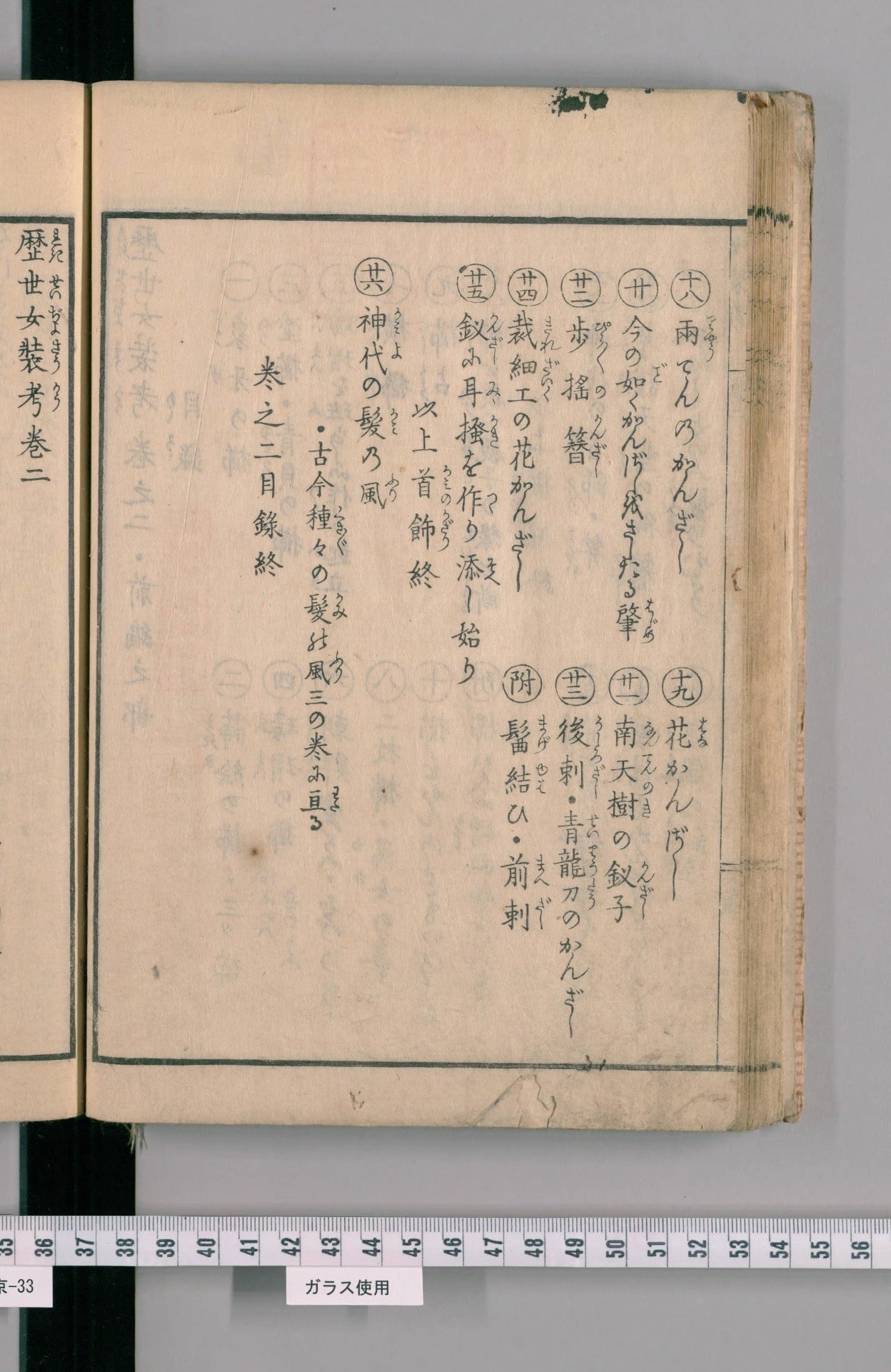
The Japanese-side draft catalogue lists the design of each of the twenty hairpins, one by one. Wisteria hat. Helmet. Yaguruma, the arrow-wheel. Bell-cricket cage. Double yaguruma. Silver butterflies. Pine, crane and cherry. Pine and crane. Stone lantern. Flowering grasses. Setsugekka, snow-moon-blossom. Plum with a birdcage. Peacock on peony. Drum and rooster. Seven-ring chrysanthemum. Matsushima. Birdcage. Moon, hare and waves. Double-thread hat. Karajishi-botan, the lion and peony. One of each. The ten combs were China pink, double chrysanthemum, clematis, cherry blossom, plum blossom, chrysanthemum, crane on pine, pine-bamboo-plum, pine-crane-chrysanthemum, and chrysanthemum on the branch.
Read only as a list of names, this is continuous with what we make now. Yaguruma, crane on pine, karajishi-botan: we would understand an order placed in those words today, without asking a single question.
What is more interesting is that this Japanese draft and the German-language official catalogue printed for Vienna agree at the level of the entry number. The German catalogue has, at no. 626, silk hair ornaments credited to Fukuda in Kyoto, and at no. 627, Haarnadeln — hairpins. The Japanese draft numbers 626 and 627 line up.
Fukuda Kichibei surfaces again four years later. At the First National Industrial Exhibition of 1877 — a domestic exposition run by the Meiji government on the world's-fair model, to survey and promote Japanese industry — Fukuda Kichibei of Teramachi Matsubara-sagaru, Kyoto, entered hana-kanzashi and artificial flowers and received a certificate of commendation. The government judge wrote that the workmanship was lustrous and pleasing, and that making sazanka blossoms out of thin cedar shavings and leaving them uncoloured was, in addition, a novel manner. The praise is for restraint: he did not dye the wood.
They had price tags
There is one more thing the Vienna catalogue draft tells us.
Each item carries two figures, marked as cost and as sale. Ten sen cost against fifty kreuzer sale. Nine sen against fifty kreuzer. Three sen five rin against thirty kreuzer. The sen was the Japanese hundredth of a yen; the kreuzer was Austrian small change. So: a production cost, and a price to sell at on the spot in Vienna.
These were not sent purely as ethnographic display. They were priced before they were crated, on the assumption that someone in Vienna would buy them.
And the party that bought the pieces and shipped them was the Kyoto prefectural government. A prefectural document records a purchase payment of two yen, fifty-four sen, three rin for "thirty pieces of hana-kanzashi and the like." The prefecture bought thirty pieces with public money and sent them to Austria. This was not one merchant's private venture. It was a region marketing itself.
A European official report names the production centres
The year after the fair, in 1874, the German official report on the Vienna exposition was published. Inside it is this sentence:
Hairpins decorated with bouquets and other ornaments made of silk, of thin gold and silver foil, or of gold- and silver-faced paper, also belong to this category, and are made chiefly in Osaka and Kyoto.
In 1873, a European official document is already writing down the materials and the production centres of the hana-kanzashi. Silk, and gold and silver paper. Osaka and Kyoto. The material list has not changed in the century and a half since; those are the things on our own workbenches this morning.
One detail is worth adding. This passage sits in the chapter on toys, immediately after a discussion of oshie, the padded-cloth pictures applied to New Year battledore paddles. The European compilers were shelving flower hairpins next to battledores, not next to fine craft. It would be easy to read that as a slight, but Japan's own official classifications later did something similar, putting oshie and tsumami-zaiku in the same category. Perhaps the two sides saw it the same way.
What we had wrong about the word "export"
This is the part of the research that surprised us most.
When you hear that tsumami-zaiku and hana-kanzashi were being exported, you picture Europe and America. We did. That is not what happened.
In 1903, the Fifth National Industrial Exhibition was held in Osaka. Its judges' report sets out the division of labour between production centres in plain terms: goods for export from Osaka; goods for the domestic market from Tokyo; tortoiseshell work from Nagasaki and Kyoto; metal hana-kanzashi from Aichi; wooden combs from Nagano and from Sakai in Senshū.
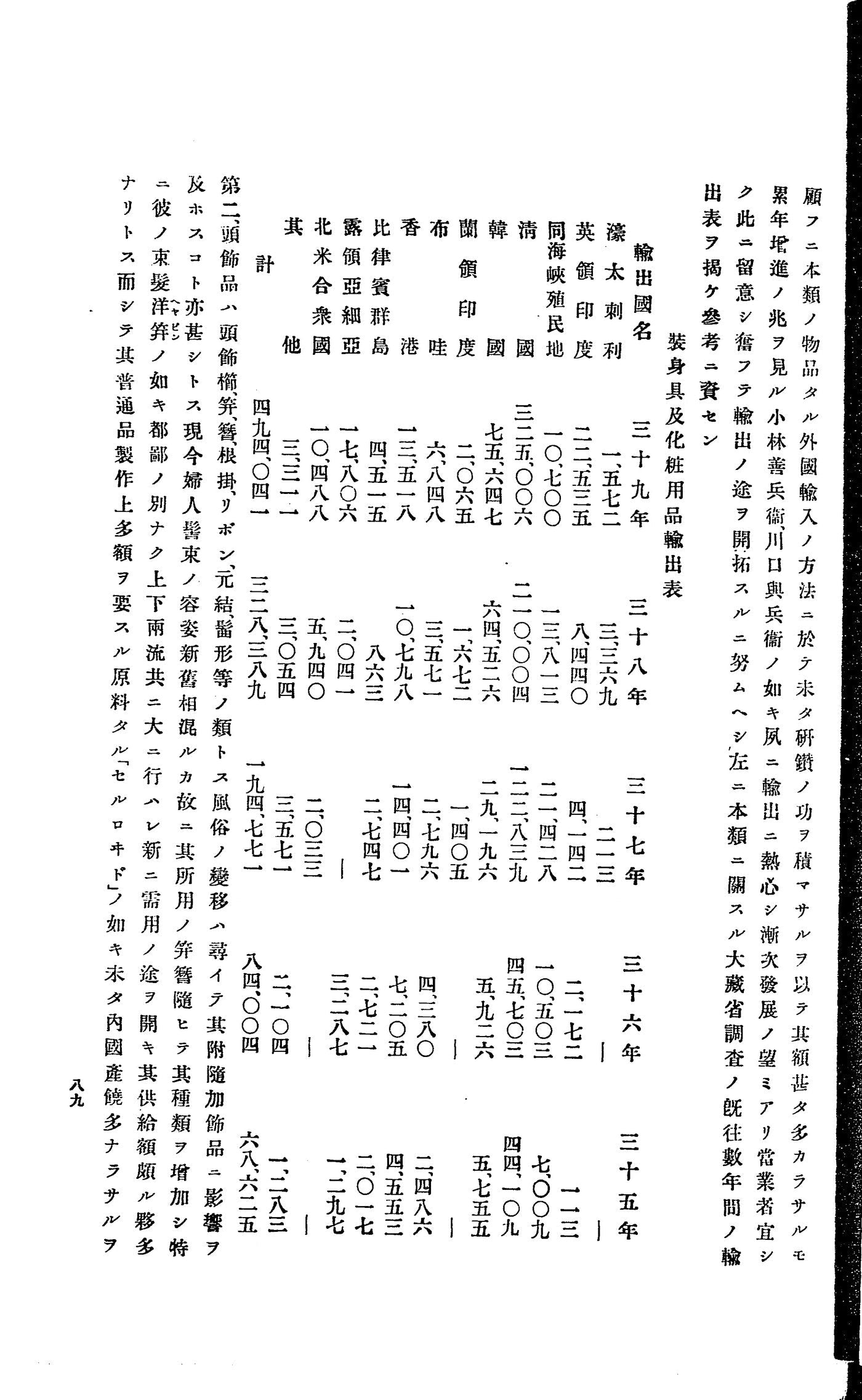
Then it names the destinations. It calls for developing and increasing the range of goods exported to China, Korea, India and elsewhere. It notes that in recent years no small quantity of mirrors, metal hana-kanzashi, combs and bracelets has been going to China, Korea, India and other Asian countries.
Not the West. Asia.
The figures back it up. The 1908 judges' report from the Tokyo Industrial Exhibition reproduces a Ministry of Finance export table for "personal ornaments and toilet articles," the category that contained kanzashi. For 1906 the total was 494,041 yen. Of that, Qing China took 325,006 yen, about 66 percent. Korea took 75,647 yen, 15 percent. The United States took 10,488 yen — 2 percent. Over the five years from 1902 the total had grown more than sevenfold. Almost all of that growth went to Asia.
There are reports from the sales floor, too. A late-Meiji trade report on Mukden, in Manchuria, describes large-headed hana-kanzashi made in Osaka, costing around twenty sen and retailing at about fifty, finding some demand among the local upper class and in the pleasure houses. The same report says that of all the artificial-flower goods on the Chinese market, hana-kanzashi sold the best.
And it was not only finished goods that were leaving. One report describes the girls' normal school in Mukden teaching artificial flowers, knitting and tsumami-zaiku, with a Tokyo firm supplying the materials and importing karume habutae, the light plain-weave silk that tsumami-zaiku is folded from. The technique and the raw silk were being exported as well.
Artificial flowers went to America; flower hairpins went to Asia
There is a second split, and it is a clean one.
A separate line item for zōka, artificial flowers, first appears in Japan's trade statistics in 1917. Before that year, neither artificial flowers nor kanzashi nor small personal goods appear as independent items in the annual tables.
In that first year, 1917, artificial-flower exports came to 108,106 yen, of which the United States took 71,801 yen, about 66 percent.
So: the Meiji category of personal ornaments was 60-odd percent China. The new Taishō category of artificial flowers was 60-odd percent America. Two mirror images.
Both were made by the same hands, out of the same silk, often in the same workshop. But the flowers that went into a hat or onto a dining table went west, and the flowers that went into hair went to Asia. They were two different markets.
As for "hana-kanzashi" itself, it never became a statistical category at all. There was a real trade body — the Tokyo Hana-Kanzashi Industrial Association existed by 1897 — and the national trademark classification had a class covering artificial flowers and hana-kanzashi. The trade tables never listed them. They stayed buried inside "personal ornaments and toilet articles" and "other miscellaneous goods." We should be careful here: this means we cannot count hana-kanzashi exports, not that there were none.
1908: the government writes "make it an export product"
The 1908 judges' report from the Tokyo Industrial Exhibition contains the passage this article was originally built around.
Part 13 of that exhibition brought together personal ornaments, head ornaments, artificial flowers, and — as a sub-entry in the same part — oshie and tsumami-zaiku goods. Tsumami-zaiku was placed next to artificial flowers, in the same class. This is among the earliest instances of the word 摘細工, tsumami-zaiku, being adopted into the classification scheme of a national exhibition.
The verdict was, frankly, poor. The judges noted that there were very few entries, that the work differed not at all from what had long been used on kanzashi, and that it amounted to gathering a few dozen tsumami flowers into a kusudama — a decorative ball — and passing it off as an interior ornament.
Then, immediately after that, comes this:
It is by no means to be treated lightly. If its application, design and invention were well judged, and it could be turned to use in export goods and the like, there would be something further to renew its present standing. The considered attention of those in the trade is to be hoped for.
An official government record, telling this handwork to apply itself to the export trade. We had to put the book down for a while after reading that.
But it needs reading precisely. The government is not saying "export hana-kanzashi." The artificial-flower section of the very same report classifies flowers for women's hair as goods for the domestic market, and lists the export lines separately as decoration for dining rooms, for evening parties, and for hats. Hair ornaments are for Japan. Tsumami-zaiku, the report is saying, could become an export product if it left the hairpin behind and took some other form.
"Tsumami-zaiku: small photograph frames and incense boxes"
A record from two years later supports that reading.
In 1910 the Japan-British Exhibition was held in London. The administrative report includes the standard used for counting exhibits, and in it tsumami-zaiku stands as its own heading. The items given as examples are these:
Small photograph frames and incense boxes: six shall count as one exhibit.
Not hairpins. Photograph frames and small boxes — objects for a Western room. Elsewhere in the same schedule, under personal ornaments, hana-kanzashi has its own separate line: one hairpin counts as one exhibit. So as of 1910, what the Japanese state pictured as tsumami-zaiku for an overseas audience was not hair ornaments. It was Western-style desk objects.
There is a nice confirmation of this from the teaching side. Joshi Gigei Tsumami-zaiku Zensho, a 1914 manual of tsumami-zaiku for women, contains a chapter on how to make a photograph holder. The item the government listed at an international exhibition is the item the textbook teaches. Making photograph frames out of folded silk was evidently a fairly ordinary idea at the time.
It did not work, though, and the government said so itself. A 1911 report from the Ministry of Agriculture and Commerce states flatly that artificial flowers, oshie, tsumami-zaiku and the like were still not sufficient to rank as important export goods. Three years after the state wrote "make it an export product," the state wrote that it had not become one.
What is still in Vienna
One last thread, and this one has no conclusion yet.
The Weltmuseum Wien holds a group of Japanese hair ornaments collected by Heinrich von Siebold, accessioned in 1889. The museum has published a photograph of the original accession ledger card, and it reads, in handwriting: Asia, Japan, Coll. Siebold. 33143 to 155, thirteen hairpins, of bone, with small bouquets of artificial flowers of silk cloth, some richly ornamented with gold-thread decoration. Thirteen pieces. Materials given as bone, silk, gold thread.
Thirteen is the correct figure, because that is what the museum's own 1889 accession record says. Only seven of the group currently have images in the online catalogue. The remaining six we have not seen; we would need to write to the museum.
Looking at the online images, our artisan's judgment is that at least two of the pieces appear to use the tsumami technique. We want to be exact about the status of that: it is a reading of photographs, by an experienced pair of eyes, and nobody from our workshop has handled the objects. It is not settled.
Something else needs saying clearly. There is no record anywhere in the museum's documentation connecting this group to the 1873 exposition. The accession is sixteen years after the fair. And Heinrich von Siebold is a different person from his elder brother Alexander, who did accompany the Japanese delegation to Vienna; whether Heinrich himself had any involvement with the exposition is something we have not been able to establish either way.
We also do not describe these pieces as goods sold for export, and we would ask that nobody else describe them that way on our account. Given that hana-kanzashi exports in fact went to Asia, treating this group as export merchandise is hard to sustain. It is more natural to read them as everyday objects, collected in Japan because Japanese women were wearing them. But that is our inference, not a documented fact.
There is exactly one way to settle it. The Japanese draft catalogue preserves the design names of those twenty 1873 hairpins — wisteria hat, yaguruma, bell-cricket cage, lion and peony, and the rest. Set those against the designs of the pieces surviving in Vienna. If they match, there is an argument to be had. If they do not, the two groups are unrelated. That is the next thing we intend to do.
A hundred and fifty years on
To put it all in one place.
In 1873, hana-kanzashi from Kyoto crossed to Vienna with prices already attached. A European official report noted that they were made of silk and gold and silver paper, in Osaka and Kyoto. But no sustained export trade to Europe or America grew out of it. What actually grew was the trade with Asia, and "hana-kanzashi" never once appeared as a line in Japan's trade statistics. In 1908 the government wrote that the craft should be turned to export goods; three years later the same government wrote that it had not been.
The assignment was never finished.
We think of what we are doing now as a continuation of it, with one change of method. Not making a great many cheap things and selling them abroad, but passing on the making itself. That each petal is folded separately. That the paste is cooked from rice starch. Why the shape comes out the way it does. Once that is understood, the price of one of these flowers explains itself. That is why we are building the video course in English.
The 1909 manual, as it happens, ran into the same problem from the other direction: its author complained that foreign buyers thought tsumami-zaiku was just a piece of shibori-dyed cloth pasted down. We wrote about that separately.
In 1909, foreign buyers didn't know each petal was folded by hand
More from this series: Is tsumami-zaiku originally Japanese? · Why tsumami-zaiku did not spread · The 1908 exposition kusudama · The kusudama was Meiji Japan's signature piece
A Japanese-language version of this article is here: 1873年、京都の花簪はウィーンへ渡っていた
About Oharibako (Kyoto)
Oharibako has been making kanzashi and kimono accessories in Nishijin, Kyoto, using pure silk and rice starch paste. Every petal is folded by hand in our own workshop.
About Oharibako · What is a kanzashi? · Maru-tsumami vs. ken-tsumami: the two basic folds
Sources
Yokomizo Hiroko, "Draft catalogue of exhibits for the Vienna World's Fair (fine and applied arts), part 3," Bijutsu Kenkyū no. 359, March 1994. National Diet Library Digital Collections, PID 7964462, image 31. The original manuscript, "Draft catalogue for sections 11 to 25," is held by the Tokyo National Museum.
Catalog der kaiserlich japanischen Ausstellung, Vienna, 1873 (Japanese Exposition Bureau). Internet Archive, catalogderkaise00japagoog. archive.org/details/catalogderkaise00japagoog
Amtlicher Bericht über die Wiener Weltausstellung im Jahre 1873, III-2, Braunschweig: Vieweg, 1874, p. 659. Internet Archive, amtlicherberich00weltgoog. archive.org/details/amtlicherberich00weltgoog
Wīn Bankokuhaku no Kenkyū (Studies on the Vienna World's Fair), which reprints the Kyoto prefectural document recording purchase payments for goods sent to the Austrian exposition. National Diet Library Digital Collections, PID 13896595 and PID 13896561, images 194-197 and 208.
Catalogue of Exhibits, First National Industrial Exhibition, 1877, vol. 4, and the accompanying Judges' Citations. National Diet Library Digital Collections, PID 801851 image 86, and PID 801856 image 199.
Judges' Report of the Fifth National Industrial Exhibition, part 7, 1904. National Diet Library Digital Collections, PID 994151, images 56-57 (same text at PID 900917, image 56).
Tokyo Kangyō Hakurankai Shinsa Hōkoku (Judges' Report of the Tokyo Industrial Exhibition), Tokyo Prefecture, December 1908; catalogued by the NDL as vol. 3, the contents corresponding to vols. 7 and 8. National Diet Library Digital Collections, PID 801790. Export table at image 61; artificial flowers at image 72; oshie and tsumami-zaiku at image 73.
Tsūshō Geppō (Monthly Trade Report) no. 187. National Diet Library Digital Collections, PID 1547088, images 3 and 5.
Report of the Commercial Museum of the Ministry of Agriculture and Commerce, no. 40, July 1911. National Diet Library Digital Collections, PID 1532271, images 6, 38 and 40.
Annual Return of the Foreign Trade of the Empire of Japan, 1917, part 1. National Diet Library Digital Collections, PID 974534, image 210.
Administrative Report of the Japan-British Exhibition Bureau, vol. 1, Ministry of Agriculture and Commerce, 1912. National Diet Library Digital Collections, PID 801796, image 171.
Statistical Tables of the Ministry of Agriculture and Commerce, 28th issue, 1911. National Diet Library Digital Collections, PID 973123, image 381 (trademark registrations by class: toys, games, artificial flowers and hana-kanzashi).
Statistical Report of Tokyo Prefecture, 1897. National Diet Library Digital Collections, PID 806577, image 161 (Tokyo Hana-Kanzashi Industrial Association).
Yoshioka Fusajirō, Joshi Gigei Tsumami-zaiku Zensho, 1914. National Diet Library Digital Collections, PID 1185204.
Weltmuseum Wien, online collection catalogue, hair ornaments Inv. 33143 and following, with the photograph of the 1889 accession ledger card. weltmuseumwien.at
English renderings and summaries are by Oharibako, Kyoto. The Meiji-era judges' reports are written in a formal Sino-Japanese register; what we give here is the substance of those passages rather than a word-for-word translation. Translations from the German sources are also ours. No images from the Weltmuseum Wien collection are reproduced here.