In 1909, Foreign Buyers Didn't Know Each Petal Was Folded by Hand
In 1909, a Japanese craftsman published a manual on tsumami-zaiku. Near the end, he set aside the technical instruction and wrote a few pages about where the craft was being sold overseas, and what buyers there made of it. One sentence in that passage describes a problem we still have today:
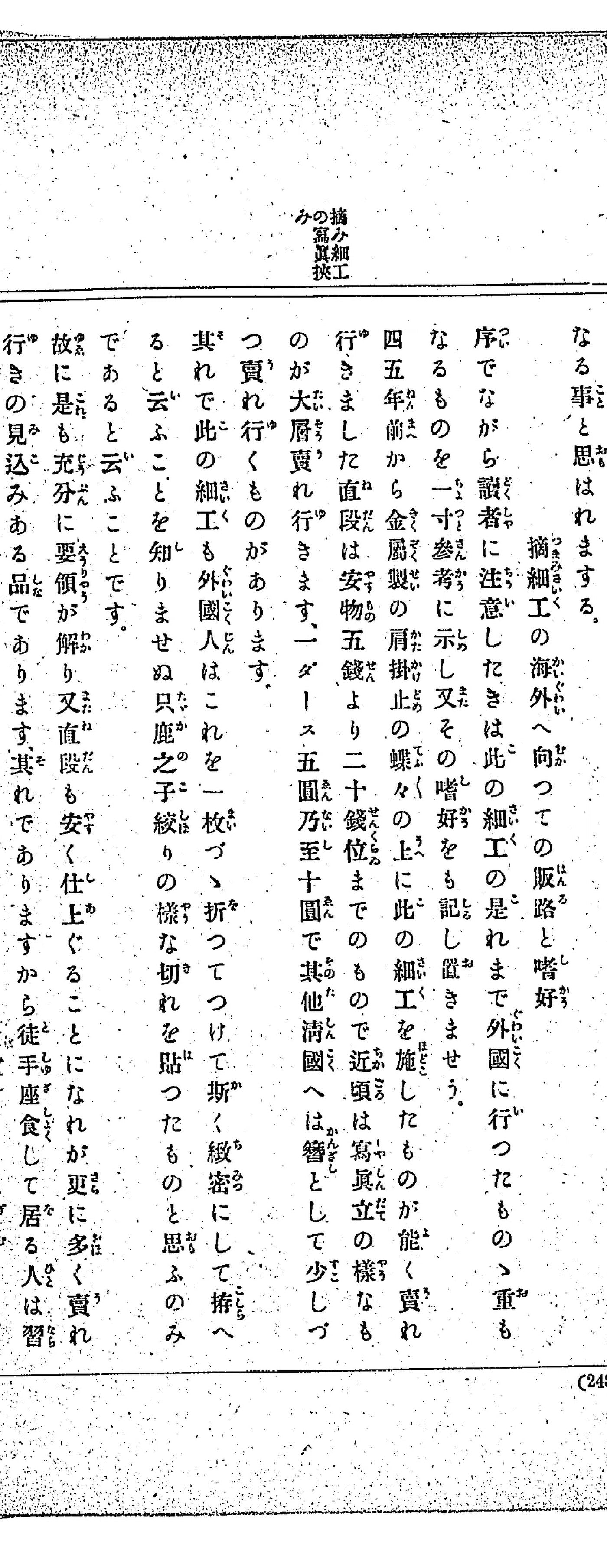
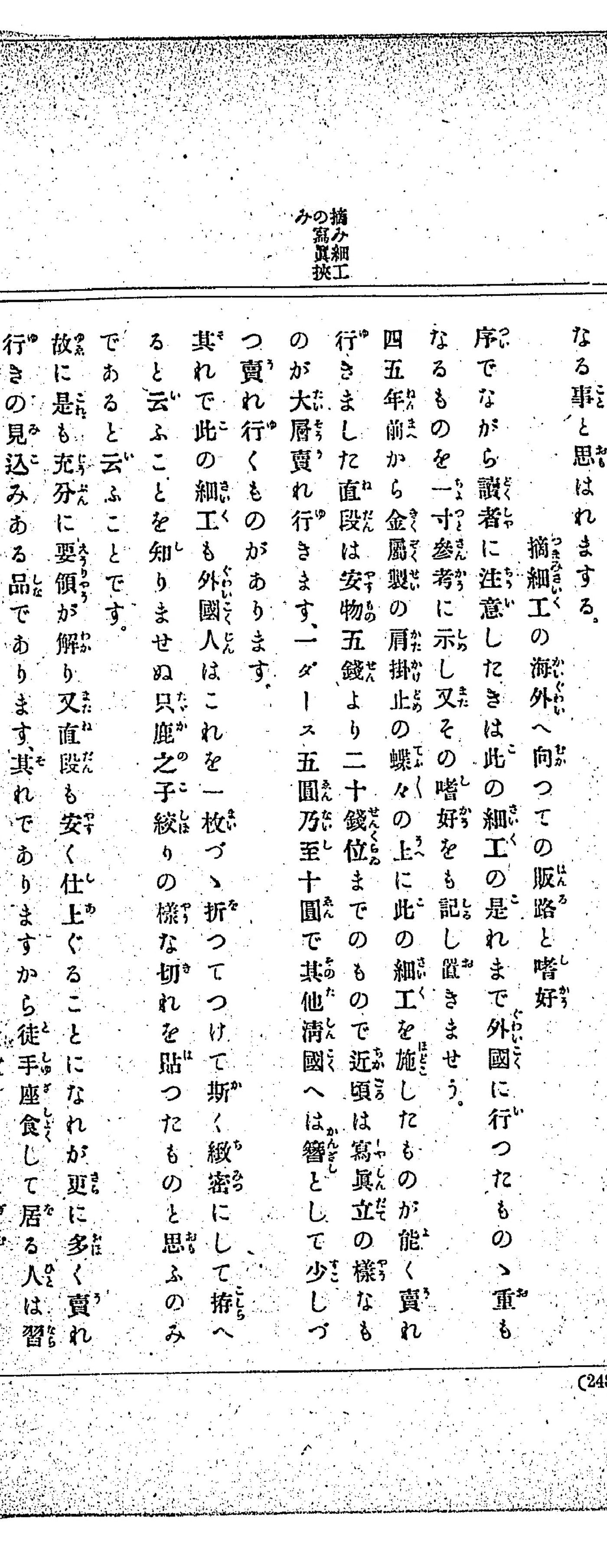
其れで此の細工も外國人はこれを一枚づゝ折つてつけて斯く緻密にして拵へると云ふことを知りませぬ 只鹿之子絞りの様な切れを貼つたものと思ふのみであると云ふことです

"Foreigners do not know that this work is made by folding the pieces one at a time and setting them, built up this finely. They think only that it is a piece of cloth like kanoko shibori, pasted on."
That was written 117 years ago. It is still, almost word for word, the thing we most often need to explain.
The source
Tsumami-zaiku Shinan (摘み細工指南, "A Guide to Tsumami-Zaiku"), by Yamada Okimatsu, published by Hakubunkan in December 1909 (Meiji 42). 278 pages, digitized in full and freely readable through the National Diet Library Digital Collections as PID 848808 (DOI: 10.11501/848808). The copyright term has expired and the National Diet Library marks it Public Domain.
The passage below is on image 138, page 248, in a late section the author titled 摘細工の海外へ向つての販路と嗜好 — "Overseas sales channels and tastes for tsumami-zaiku." The marginal heading on that page reads 摘み細工の寫眞挾み, "tsumami-zaiku photo frames."
Yamada Okimatsu headed a school of artificial-flower technique and had trained in both that craft and tsumami-zaiku. He is writing here as a working professional reporting what he had been told about his own export trade — not as a historian.
Earlier in this series: Is tsumami-zaiku originally Japanese? · Why tsumami-zaiku did not spread · The 1908 exposition kusudama
What was actually being exported in 1909
Before the sentence about foreign buyers, the author lists what had been selling abroad, with prices. This is his own account of the trade, item by item:
四五年前から金屬製の肩掛止の蝶々の上に此の細工を施したものが能く賣れ行きました直段は安物五錢より二十錢位までのもので近頃は寫眞立の様なものが大層賣れ行きます、一ダース五圓乃至十圓で其他清國へは簪として少しづつ賣れ行くものがあります
In English: "For the past four or five years, metal shawl clasps with a butterfly, worked over with this craft, have sold well. Prices ran from five sen for the cheap ones up to about twenty sen. Recently, things like photo frames sell very well, at five to ten yen a dozen. Besides these, a small quantity sells to Qing China as kanzashi."
- Shawl clasps with tsumami butterflies, from about 1904–05 — 5 to 20 sen each
- Photo frames, the current hit at the time of writing — 5 to 10 yen per dozen
- Kanzashi to Qing China — small volumes
Worth noting what is not on that list. The export trade was not in hair ornaments. It was in shawl clasps and photo frames — tsumami-zaiku applied to objects a Western household already used. The kanzashi went to China, not to the West.
Why buyers thought it was shibori cloth
Kanoko shibori is a Japanese tie-dye technique. Cloth is bound in small points before dyeing, and the result is a field of tiny puckered dots — the name means "fawn spots," after the dappling on a young deer. The finished fabric has a raised, bumpy surface.
Set a tsumami-zaiku flower next to it, and you can see the confusion. Dozens of small folded silk petals massed together also read, from any distance, as a bumpy textured surface. A buyer who had never watched the work being done would reasonably assume the maker had cut a piece of patterned cloth and glued it into place.
What that buyer could not see is that every one of those bumps is a separate square of silk, folded with tweezers, its cut edge set into rice starch paste, and placed by hand. A single piece can take hundreds of them.
The author's own conclusion follows immediately:
故に是も充分に要領が解り又直段も安く仕上ぐることにでもなれば更に多く賣れ行きの見込みある品であります
"Therefore, if this too were properly understood, and if it could be finished at a lower price, it is a product with the prospect of selling in far greater quantity."
Two conditions, in his order: be understood, and be cheaper. He put comprehension first.
What the source establishes, and what it doesn't
This is one professional's account, written in 1909, of what he had heard about how his craft was received abroad. It is not a market survey and it names no buyer, no country in the West, and no source for the claim. We can't treat "foreign buyers thought it was shibori cloth" as a documented fact about all export markets; what the source establishes is that a working Japanese craftsman in 1909 believed this was the problem, and wrote it down in print alongside the prices his goods were fetching.
We're also not going to claim a straight line from 1909 to now. The trade he describes — shawl clasps and photo frames sold by the dozen — is not the trade we're in. What struck us is narrower than that: the specific misunderstanding he identified, and the order of his two conditions.
The part that hasn't changed
We sell kanzashi and tsumami-zaiku materials to customers outside Japan. The single most common thing we find ourselves explaining is exactly what Yamada wrote down in 1909: that the petals are not printed, not patterned cloth, not stamped or moulded. Each one is a square of pure silk, folded by hand with tweezers, one at a time.
A photograph flattens this. That is as true of a product listing today as it was of a shawl clasp in a shop abroad in 1905. If you can't see the folding happen, there is nothing in the finished object that announces it.
Which is why we keep writing these articles, and why we film the work. Not because the craft needs defending — because, as the man who wrote the first manual on it noticed, it doesn't explain itself.
About Oharibako (Kyoto)
Oharibako has been making kanzashi (traditional Japanese hair ornaments) and kimono accessories in Nishijin, Kyoto, using pure silk and rice starch paste. Every petal is folded by hand in our own workshop.
Maru-Tsumami vs. Ken-Tsumami: The Basic Folds
Hana Kanzashi: How We Make Them
Silk vs. Synthetic Fabric in Kanzashi
Source
Yamada Okimatsu, Tsumami-zaiku Shinan (摘み細工指南), Hakubunkan, December 1909. Section: 摘細工の海外へ向つての販路と嗜好, page 248. National Diet Library Digital Collections, PID 848808 (DOI: 10.11501/848808), image 138. Public domain. All quotations transcribed directly from the original scanned page.